Harren Hoare
Fire & BloodHarren Hoare, remembered as Harren the Black, was King of the Isles and the Rivers, a ruler whose long reign joined conquest and coercion to the construction of Harrenhal. His fortress was meant to embody the security of his rule, but when the riverlords turned against him, it became the place where his dynasty ended and Ironborn authority over the Trident was broken.
Identity and Rule
Harren ruled the riverlands as a member of House Hoare, whose hold on the region had been established through successive generations of conquest. His ironborn grandsire, Harwyn Hardhand, had taken the Trident from Argilac’s grandsire, Arrec; Harren’s father later extended the family’s domains eastward to Duskendale and Rosby. Harren inherited a realm acquired by force, and his kingship remained bound to that history of domination.
The book describes his rule as lasting close to forty years and presents him as the most feared king in Westeros. His reputation rested not simply on military power: his cruelty had become legendary, while the people he governed in the riverlands had little affection for their Ironborn overlords. The contrast between the breadth of House Hoare’s conquests and the weakness of its loyalty would become decisive when Aegon Targaryen invaded.
Harrenhal and the Reach of His Ambition
For most of his reign, Harren devoted himself to building a vast castle beside the Gods Eye. The project consumed the resources of the riverlands: thousands died during its construction, materials were plundered, and both lords and smallfolk were impoverished by Harren’s demand for gold. As Harrenhal neared completion, the Ironborn would, in principle, be free to pursue further conquests. Instead, the fortress drew the accumulated costs of his rule into one monumental structure.
Harrenhal was the largest castle in Westeros, with five immense towers, abundant fresh water, deep vaults stocked with provisions, and walls of black stone said to be too high for ladders and too thick for conventional siege engines. These features made the castle formidable against an ordinary assault. They also encouraged Harren to treat its defenses as decisive, even when the danger came not from a siege engine but from a power that could pass over the walls.
The Riverlords’ Revolt
When Aegon joined forces with Edmyn Tully and the other riverlords, Harren’s political position collapsed with startling speed. Tully, Lord of Riverrun, had been summoned to help defend Harrenhal; instead, he declared for House Targaryen, raised the dragon banner above his castle, and brought his knights and archers to Aegon. His defiance gave other lords of the Trident the confidence to renounce Harren in turn. The Blackwoods, Mallisters, Vances, Brackens, Pipers, Freys, and Strongs gathered their levies and descended on Harrenhal.
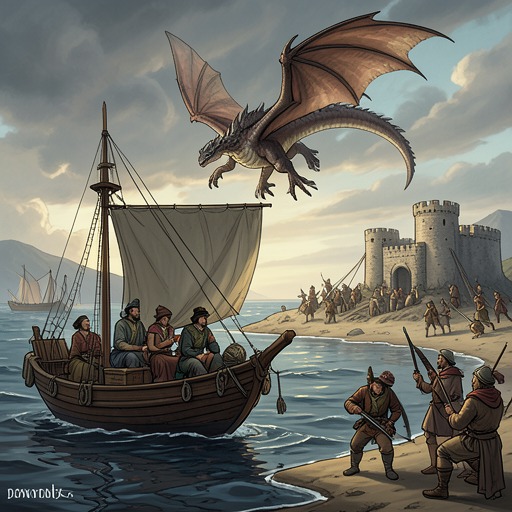
Outnumbered, Harren withdrew into the stronghold he had spent decades building. Aegon had eight thousand men outside the walls and offered Harren terms: he could remain lord of the Iron Islands, and his sons could succeed him. Harren rejected the terms on the grounds that the strength of his walls made the besieging army irrelevant. Aegon warned that the walls could not keep out dragons. Harren returned to the castle, placed men along its defenses, and offered lands and wealth to whoever could bring down the dragon. His response turned the coming confrontation into a test of the confidence he had placed in stone.
Fall and Aftermath
As darkness gathered, Harren’s defenders saw no dragon and could have taken Aegon’s threat for an empty one. Aegon had instead taken Balerion high above the clouds, then descended inside the castle walls. Balerion’s attack set the towers and the provisions within the fortress alight; even the stone, the feature Harren had trusted most, could not preserve the castle from the dragon’s fire. Harren and his remaining sons died in the burning fortress that night, bringing House Hoare to an end.
The consequences extended beyond Harren’s death. House Hoare’s hold on the riverlands ended with him, and the next day Aegon accepted Edmyn Tully’s oath of fealty and named him Lord Paramount of the Trident. The other riverlords also did homage, recognizing Aegon as king and Tully as their liege lord. Swords gathered from the ruined castle were carried by wagon to the Aegonfort, a final material trace of the defeat that accompanied the transfer of political power.
Narrative Significance
Harren’s fall joins the physical scale of Harrenhal to the political fragility of the regime it was intended to secure. The castle’s stores, towers, water, and walls could resist familiar forms of attack, but they could not repair the alienation caused by the labor and wealth extracted to build them, nor restore the riverlords’ allegiance once they had chosen another king. Harren’s confidence in the walls thus becomes the central irony of his end: the fortress that expressed his ambition could not protect either his family or his rule.
His defeat also shows how Aegon’s conquest changed the political order of the riverlands. Harren’s death removed House Hoare, but the region’s lords had already made their own consequential choice by declaring for Aegon. The settlement that followed placed Edmyn Tully over the Trident, replacing Ironborn rule with a lordship grounded in the riverlords’ new allegiance. Harren is therefore remembered not only as the king who lost Harrenhal, but as the ruler whose fall made that transfer possible.